Salt, Steel, and Silence: The Undercarriage Corrosion Crisis Dealerships Rarely Discuss
There is a particular kind of automotive failure that arrives without warning — not because the warning signs were absent, but because they were invisible. Undercarriage corrosion operates precisely this way. By the time a driver notices surface rust on a brake line or a compromised suspension mount, the structural integrity of those components may have been degrading for years. The damage is real, it is expensive, and in the most serious cases, it is dangerous. What makes this problem particularly frustrating is that much of it is preventable — provided owners understand what dealerships often omit from their rust-proofing conversations.
How Corrosion Works Beneath Your Vehicle
The undercarriage of a modern vehicle is an engineering marvel, but it is also a collection of ferrous metals operating in one of the harshest micro-environments imaginable. Road salt — applied liberally across northern and midwestern states from October through April — is a highly effective corrosion accelerant. Sodium chloride and magnesium chloride compounds lower the freezing point of water while simultaneously disrupting the oxide layer that forms naturally on steel surfaces. This disruption allows moisture to penetrate the metal itself rather than sitting on its surface.
What complicates matters further is the geometry of the undercarriage. Hollow sections in frame rails, recessed pockets around suspension mounts, and the crimped edges of brake line brackets all trap moisture and road debris. These areas dry slowly, if at all, during winter months. The corrosion that develops in these concealed spaces is electrochemical and progressive — it does not pause between seasons.
Brake lines are among the first casualties. Most factory brake lines are constructed from steel tubing with a thin protective coating. Once that coating is compromised, internal corrosion can reduce wall thickness to a fraction of its original specification before any external pitting becomes apparent. A brake line that looks merely surface-rusty may already be structurally unsuitable for the hydraulic pressures it experiences during hard stops.
The Regional Reality: Not All Driveways Are Equal
Corrosion risk is not uniform across the United States, and any honest discussion of undercarriage protection must account for geography. The so-called "Rust Belt" — encompassing states like Michigan, Ohio, Pennsylvania, New York, and Wisconsin — represents the highest-risk environment due to the combination of heavy salt application, freeze-thaw cycling, and extended winter seasons. A vehicle driven exclusively in these states for ten years faces a fundamentally different corrosion trajectory than the same model operated in Arizona or southern California.
Coastal environments introduce a different but equally serious threat. Salt air and coastal humidity accelerate oxidation even without road salt exposure. Vehicles in Florida, along the Gulf Coast, and in Pacific coastal cities like Seattle often develop undercarriage corrosion in ways that surprise owners accustomed to thinking of rust as a northern problem.
For owners in low-risk regions, the calculus around rust-proofing is genuinely different. Aggressive treatments may represent unnecessary expenditure. For those in high-risk zones, however, undercarriage protection is not a luxury — it is maintenance.
What Dealership Rust-Proofing Packages Actually Cover
New vehicle dealerships frequently offer rust-proofing or corrosion protection packages at the point of sale, often priced between $300 and $1,500. These packages deserve scrutiny. Many rely on spray-on coatings applied to visible undercarriage surfaces — a process that addresses cosmetic corrosion concerns without penetrating the enclosed sections where serious structural degradation originates.
Drip-oil injection systems, which force a penetrating oil compound into frame cavities and enclosed sections through pre-existing access points, represent a more technically sound approach. However, not all dealerships offer this method, and those that do vary considerably in application quality. Rubberized undercoating sprays, while effective at protecting flat surfaces, can actually trap moisture if applied over existing corrosion or if they develop cracks over time — creating the very conditions they were intended to prevent.
The honest assessment is this: dealership packages are frequently designed around what is easy to apply and easy to demonstrate to a customer, rather than around the specific failure points that generate the costliest repairs.
The Parts That Fail First — and What to Do About Them
Understanding which components are most vulnerable allows owners to prioritize inspections and replacements intelligently.
Brake lines and fittings represent the most safety-critical corrosion risk. Replacement brake lines constructed from stainless steel or coated nickel-copper alloy (commonly sold under the NiCopp trade name) offer dramatically superior corrosion resistance compared to factory steel lines. For owners in high-salt regions with vehicles approaching ten years of age, proactive brake line inspection and potential replacement is a defensible maintenance decision.
Suspension components — including control arm bushings, ball joints, and sway bar end links — corrode at their mounting hardware and at the interfaces between dissimilar metals. Seized bolts discovered during a routine suspension inspection can turn a $200 part replacement into a $600 labor job simply due to extraction difficulty. Anti-seize compound applied during reassembly is inexpensive insurance against this outcome.
Exhaust system hangers and heat shields are frequently the first visible evidence of undercarriage neglect. While their failure is rarely catastrophic, the rattles they generate often prompt shop visits that reveal more serious underlying corrosion.
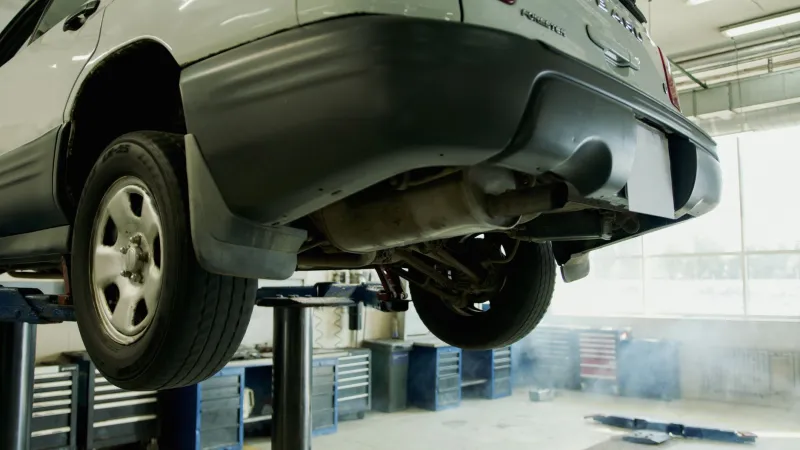
Frame mounting points for subframes and body mounts represent the most structurally significant corrosion concern on unibody vehicles. These areas are difficult to inspect without a lift and are rarely included in standard service checks.
A Practical Protection Framework
For owners committed to extending undercarriage life, a layered approach yields the best results. Annual undercarriage inspection by a qualified technician — ideally on a lift, with a light source and a probe to test metal integrity — establishes a baseline. In high-salt regions, a post-winter pressure wash of the undercarriage, followed by a summer application of a penetrating cavity wax into accessible frame sections, meaningfully reduces cumulative corrosion.
When replacement parts become necessary, material selection matters. Stainless steel hardware, corrosion-resistant coated brake components, and galvanized suspension hardware cost modestly more than standard replacements but extend service life considerably in corrosive environments.
The undercarriage is not glamorous. It generates no dashboard warning lights, and its deterioration rarely announces itself until a failure occurs. But for owners in corrosion-prone regions, treating it as a maintenance priority — rather than an afterthought addressed only at the point of crisis — is among the most cost-effective decisions a vehicle owner can make.