Penny Wise, Dollar Foolish: The True Financial Toll of Discount Auto Parts
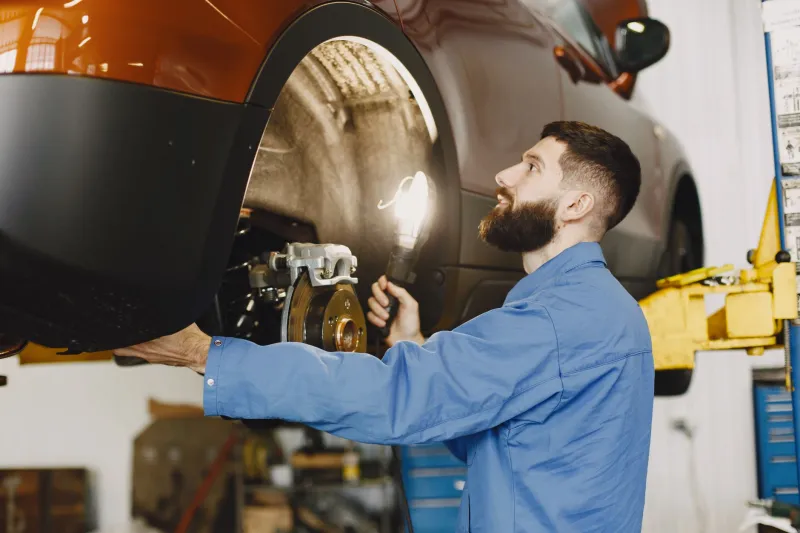
When a brake pad set lists for $18.99 and a reputable alternative sits at $64.00, the arithmetic seems obvious. Pocket the difference, get the car back on the road, and move on. That logic, however, assumes the cheaper component performs comparably over its service life — an assumption that independent repair data and seasoned mechanics consistently challenge.
At AutoPartsPro, we work with vehicle owners across every make and model, and the pattern we observe is remarkably consistent: the parts that appear most affordable at the point of purchase frequently become the most expensive decisions a driver makes all year.
What "Cheap" Actually Means in a Manufacturing Context
Price differences in the auto parts market rarely reflect retail markup alone. They typically signal real distinctions in raw material sourcing, metallurgical composition, dimensional tolerancing, and quality control processes. A discount rotor, for instance, may be cast from lower-grade iron with inconsistent carbon content, resulting in uneven heat dissipation and surface warping within 15,000 to 20,000 miles — well short of the 50,000-plus miles a quality unit routinely delivers.
Similarly, budget oxygen sensors often use thinner platinum or palladium coatings on their sensing elements. The sensor may read accurately for the first several months, then begin producing erratic voltage signals that confuse the engine control unit, triggering rich fuel trims, reduced fuel economy, and, eventually, catalytic converter stress. What began as a $22 sensor purchase can evolve into a $900 to $1,400 catalytic converter replacement.
The Cascading Damage Problem
Perhaps the most underappreciated financial risk of low-quality components is their tendency to degrade adjacent systems. Automotive engineers design vehicle systems as integrated assemblies; when one component underperforms, neighboring parts absorb compensatory stress.
Consider a real-world scenario that independent repair shops across the United States report with notable frequency:
Scenario: Budget Wheel Bearing A driver replaces a worn wheel bearing with a no-brand unit priced at $31, compared to a quality bearing at $89. Within 14 months, the budget bearing develops excessive play. That play introduces lateral runout to the brake rotor, accelerating pad wear and causing pulsation. The driver replaces pads earlier than expected. The runout also stresses the CV axle boot, which cracks and allows grease to escape, contaminating the brake components and eventually requiring a full CV axle replacement.
Total cost of the "$31 savings" decision: approximately $520 in additional parts and labor, not counting the original bearing replacement itself.
This cascade dynamic is not an edge case. A 2022 survey conducted by the Automotive Aftermarket Suppliers Association found that nearly 34 percent of premature component failures in vehicles under 120,000 miles were attributable to the installation of substandard replacement parts rather than normal wear.
Real Cost Comparisons Across Common Part Categories
The following comparisons reflect average US retail pricing and typical replacement intervals based on industry repair data:
Brake Pads
- Budget tier ($18–$28 per axle set): Average service life of 18,000–25,000 miles. Elevated brake dust, moderate fade under hard braking.
- Mid-grade / OEM-equivalent ($55–$85 per axle set): Average service life of 40,000–55,000 miles. Consistent bite, minimal rotor scoring.
- Cost per 100,000 miles — budget tier: $72–$155 in parts alone, plus additional rotor resurfacing or replacement from accelerated wear.
- Cost per 100,000 miles — mid-grade: $100–$170 in parts, with rotors typically surviving full service intervals.
Serpentine Belts
- Budget tier ($12–$18): Rubber compounds with lower heat and ozone resistance. Cracking reported at 40,000–50,000 miles in warmer climates.
- Quality tier ($28–$45): EPDM construction rated to 100,000 miles in most applications.
- A failed serpentine belt at highway speed disables power steering, the alternator, and the water pump simultaneously. A resulting roadside tow averages $125–$200 in most US metro areas, before any secondary repair costs.
Engine Air Filters
- Budget tier ($6–$10): Filtration efficiency ratings frequently 10–15 percentage points below OEM specification. Particulate bypass accelerates cylinder wear over time.
- Quality tier ($18–$30): Meets or exceeds OEM filtration efficiency. Maintains airflow consistency throughout service interval.
- The long-term cost of marginally higher particulate ingestion is difficult to isolate in a single repair bill, but engine rebuilds attributable to accelerated cylinder and ring wear routinely run $3,000 to $7,000 at independent shops.
What Mechanics Are Telling Their Customers
We spoke with several ASE-certified technicians about their observations regarding part quality and return visits.
"I can almost predict which customers I'll see again in six months," said one master technician with 22 years of experience at a mid-sized shop in the Dallas–Fort Worth area. "If someone brings their own parts from one of those deep-discount online warehouses, I document it carefully, because there's a reasonable chance we'll be revisiting that repair."
A shop owner in the Chicago suburbs noted a specific pattern with imported budget struts: "We've seen strut assemblies lose damping capacity in under 20,000 miles. The customer thinks they're saving $80 per corner. What they don't account for is that worn struts accelerate tire wear — sometimes 30 to 40 percent faster — and compromise alignment stability. By the time they need new tires ahead of schedule, they've spent three times what they saved."
A Framework for Calculating True Cost of Ownership
Before selecting a part based on sticker price, apply this straightforward framework:
-
Divide the part cost by the expected service life in miles. A $25 part lasting 25,000 miles costs $1.00 per thousand miles. A $70 part lasting 60,000 miles costs $1.17 per thousand miles — but carries significantly lower risk of secondary damage.
-
Factor in labor. If your vehicle requires two hours of shop labor at $120/hour to access the component, a part that fails twice costs you $480 in labor alone, on top of two sets of parts.
-
Assign a probability weight to cascade failure. Budget components in safety-critical or load-bearing categories carry meaningfully higher failure risk. Assign at least a 20–30 percent probability of an adjacent repair event and include that in your calculation.
-
Account for roadside contingencies. Towing, rental vehicles, and missed work represent real costs that rarely appear in a simple parts price comparison.
Where Budget Parts Are Acceptable — and Where They Are Not
Not every vehicle component carries equal consequence if it underperforms. Interior trim clips, cabin air filters, and non-structural body plugs represent categories where a lower-cost option carries minimal downstream risk. Spending aggressively on a cabin air filter accomplishes little beyond marginal filtration improvement.
Conversely, components in the following categories warrant a strong bias toward quality-tier options:
- Brake system components (pads, rotors, calipers, hoses)
- Steering and suspension (tie rods, ball joints, control arm bushings)
- Engine management sensors (O2 sensors, MAF sensors, crankshaft position sensors)
- Cooling system components (water pumps, thermostats, radiator hoses)
- Wheel bearings and hub assemblies
In these systems, failure consequences extend well beyond the component itself — and in the case of brakes and steering, into the realm of personal safety.
The Bottom Line
The auto parts market offers an extraordinary range of price points, and navigating it wisely requires more than a reflexive preference for the lowest number on the screen. True cost of ownership is a function of service life, labor exposure, cascade risk, and safety implications — variables that a sticker price cannot convey.
At AutoPartsPro, our catalog is built around parts that deliver genuine value across that full spectrum of considerations. Quality components, sourced for every make and every model, are not a premium indulgence. For most vehicle owners doing the complete math, they are simply the more economical choice.