The $50 Part That Can Destroy a $5,000 Engine: What Every Driver Needs to Know About Thermostat Failure
Most drivers, when asked to name the components most critical to their engine's survival, will rattle off the usual suspects: oil, spark plugs, timing belts. Almost no one mentions the thermostat. That oversight is understandable — the thermostat is small, inexpensive, and buried beneath layers of hoses and housings that most people never think to examine. But that quiet anonymity is precisely what makes thermostat failure so dangerous.
A functioning thermostat is your engine's thermal gatekeeper. When it stops doing its job — whether it fails open, fails closed, or simply begins sticking intermittently — the consequences can escalate with alarming speed. What starts as a mildly erratic temperature gauge can end with a warped cylinder head, a blown head gasket, or worse. Repair estimates in those scenarios routinely exceed $3,000, and in severe cases, complete engine replacement becomes the only viable option.
Understanding this component — what it does, how it fails, and what warning signs precede catastrophe — is not optional knowledge for informed vehicle ownership. It is essential.
What a Thermostat Actually Does
The thermostat is a thermally activated valve positioned between the engine and the radiator. Its sole function is to regulate coolant flow based on engine temperature. When a cold engine is first started, the thermostat remains closed, allowing the engine to reach its optimal operating temperature — typically somewhere between 195°F and 220°F depending on the vehicle — as quickly as possible. Once that threshold is reached, the thermostat opens, permitting coolant to circulate through the radiator and dissipate heat.
This regulation matters more than most drivers appreciate. Engines are precision machines engineered to operate within narrow thermal windows. Run too cold, and fuel combustion becomes inefficient, oil viscosity remains elevated, and internal wear accelerates. Run too hot, and metal components expand beyond design tolerances, gaskets fail, and aluminum cylinder heads can warp in a matter of minutes.
The thermostat keeps your engine walking that line — constantly, automatically, and without any input from the driver. When it stops doing so reliably, that line disappears.
The Two Failure Modes — And Why One Is Far More Dangerous
Thermostats fail in two distinct ways, and they carry very different consequences.
Failure in the open position means the thermostat valve stays permanently open, allowing coolant to circulate continuously even when the engine is cold. The engine struggles to reach proper operating temperature, fuel economy suffers, and the heater may perform poorly — particularly noticeable during cold New England winters or high-altitude Rocky Mountain drives. This failure mode is inconvenient and costly over time, but it is rarely an immediate emergency.
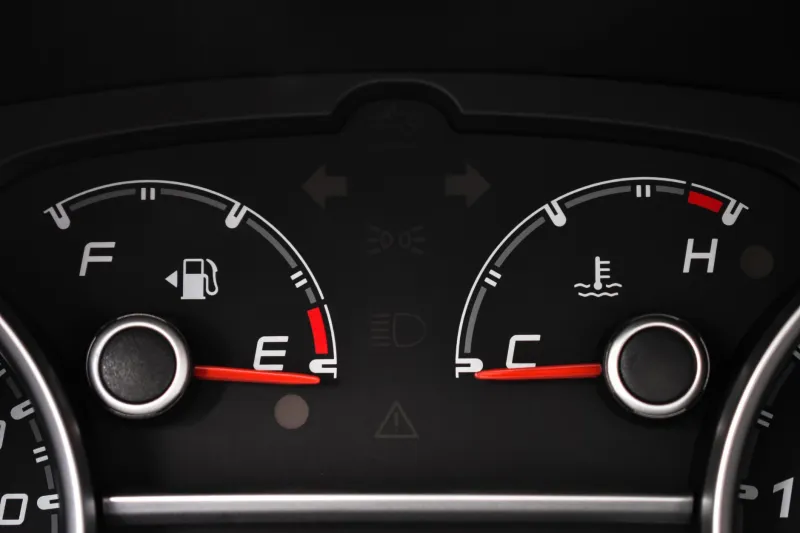
Failure in the closed position is an entirely different situation. When the thermostat valve sticks shut, coolant cannot flow to the radiator. Heat builds rapidly and without relief. The temperature gauge climbs. If the driver does not notice — or ignores the warning — the engine begins to overheat in earnest. Coolant boils, pressure spikes, and the weakest points in the system begin to fail. Head gaskets, which seal the combustion chamber from the coolant passages, are particularly vulnerable. Once a head gasket fails, coolant enters the combustion chamber, oil passages become contaminated, and the engine begins consuming itself.
This entire sequence can unfold within minutes of a thermostat seizing closed at highway speeds.
Why Mechanics Miss Early Thermostat Warning Signs
Part of what makes thermostat failure so insidious is that early symptoms are easy to misattribute. An intermittently sticking thermostat — one that opens and closes erratically before failing completely — produces symptoms that mimic a dozen other problems.
A temperature gauge that fluctuates more than usual? Could be a failing sensor. Slightly reduced fuel economy? Attributed to driving habits or seasonal fuel blend changes. A heater that takes longer than expected to warm up on a cold morning? Dismissed as a quirk of an aging vehicle.
Many independent shops and even dealership service departments focus diagnostic attention on the components most commonly associated with overheating: the water pump, the radiator, the coolant reservoir. The thermostat, because of its low cost and simple function, is often the last item examined rather than the first.
This diagnostic sequence is backwards. Given that thermostats cost between $15 and $80 for most domestic and import vehicles, and that labor to replace one rarely exceeds two hours, the thermostat should be among the first components evaluated when any cooling system anomaly appears.
Diagnostic Signs You Should Never Ignore
Drivers who know what to look for can often catch a thermostat problem before it escalates. The following indicators warrant immediate attention:
- Temperature gauge behavior that is inconsistent — climbing higher than normal, taking significantly longer to reach operating temperature, or fluctuating during steady highway driving.
- Coolant smell without visible leaks — an early sign of pressure buildup or minor gasket stress that can precede more serious failure.
- Heater performance degradation — particularly a heater that blows cool air when the engine should be fully warmed up, suggesting coolant is not circulating properly through the heater core.
- White exhaust smoke on a warm engine — a warning sign that coolant may already be entering the combustion chamber, indicating the damage cascade may have already begun.
- Coolant loss without an obvious external leak — coolant that disappears without pooling beneath the vehicle is often being burned internally, a serious indicator of head gasket compromise.
If any of these symptoms appear, the vehicle should be evaluated promptly. Continuing to drive an overheating engine — even briefly — compounds damage exponentially.
Replacement Parts: What to Look For
When replacing a thermostat, quality selection matters more than the low price tag might suggest. OEM-specification thermostats are engineered to open at the precise temperature your vehicle's engine management system expects. Cheap, off-brand replacements may open too early (mimicking a stuck-open failure) or carry inconsistent manufacturing tolerances that shorten service life.
For most vehicles, a quality OEM or OEM-equivalent thermostat from a reputable supplier represents the correct balance of cost and reliability. It is also standard practice to replace the thermostat housing gasket or O-ring at the same time — attempting to reuse an old gasket is a false economy that frequently results in coolant leaks immediately following the repair.
Some mechanics recommend replacing the thermostat as a matter of course during major cooling system service — water pump replacement, radiator work, or timing belt jobs that require partial disassembly of the cooling system. The incremental cost of adding a thermostat to those jobs is minimal. The cost of returning to address a thermostat failure six months later is not.
The Broader Lesson in a Small Part
The thermostat's story is a useful illustration of a principle that applies across vehicle maintenance: the components that cost the least to replace are frequently the ones whose failure costs the most to repair. Ignoring a $50 thermostat because it seems insignificant is the same reasoning that allows a $30 oxygen sensor to quietly waste hundreds of dollars in fuel, or a worn $25 serpentine belt to strand a driver on the interstate.
Informed vehicle ownership means understanding which low-cost components carry outsized consequences — and treating them with the seriousness they deserve. Your engine's cooling system is not forgiving of neglect, and the thermostat sits at the center of it.
If your temperature gauge has been behaving oddly, if your heater seems slower to warm than it once was, or if it has simply been more than 60,000 miles since anyone looked at your thermostat, now is the appropriate time to act. The cost of a quality replacement part and a routine service appointment is a fraction of what a warped head or a failed gasket will demand.
At AutoPartsPro, we stock thermostats for virtually every make and model on American roads — domestic trucks, import sedans, European performance vehicles, and everything in between. Quality parts, properly matched to your vehicle, are the foundation of maintenance done right.