Regional Reckoning: The Cold-Weather Parts Failures That Catch Unprepared Drivers Every Winter
America is not one automotive climate. A pickup truck driven year-round in Phoenix faces an entirely different set of mechanical stresses than the same model driven through five Minnesota winters. Yet the national conversation about vehicle maintenance tends to treat all cars, in all regions, as if they operate under identical conditions. For drivers in cold-weather states, this one-size-fits-all approach has a measurable financial cost—and sometimes a safety cost as well.
This article approaches vehicle maintenance through a geographic lens, examining the specific components most vulnerable to cold-climate stress and building a practical, region-by-region framework for preventative action.
The Cold-Weather Threat Map
The contiguous United States can be broadly divided into three automotive climate zones for maintenance planning purposes:
High-stress cold zones include the Upper Midwest (Minnesota, Wisconsin, Michigan, the Dakotas), the Mountain West (Montana, Wyoming, Colorado at elevation), and most of New England. These regions experience sustained temperatures below 20°F, significant snowfall, and—critically—heavy road salt application that creates a corrosive chemical environment beneath every vehicle.
Moderate cold zones include the Mid-Atlantic, the Pacific Northwest, the Great Plains, and the Midwest's transitional states. These regions experience meaningful freezing temperatures and occasional severe weather but without the sustained extremes of the high-stress zones.
Mild zones include the Southeast, the Gulf Coast, Southern California, and most of the Desert Southwest. Drivers in these regions rarely encounter the specific failure modes discussed below—but those who relocate northward or purchase used vehicles from northern states should understand the accelerated wear those vehicles may have already sustained.
Battery Terminals and Cold Cranking Capacity: The First Casualty
No component fails more predictably in cold weather than the automotive battery—and no failure mode is more frequently preventable. Cold temperatures reduce a battery's cranking capacity by measurable percentages: a battery at 0°F delivers roughly 40 percent less power than the same unit at 80°F. A battery operating near the end of its service life in a temperate climate may function adequately through a mild autumn and fail completely on the first genuinely cold morning of the year.
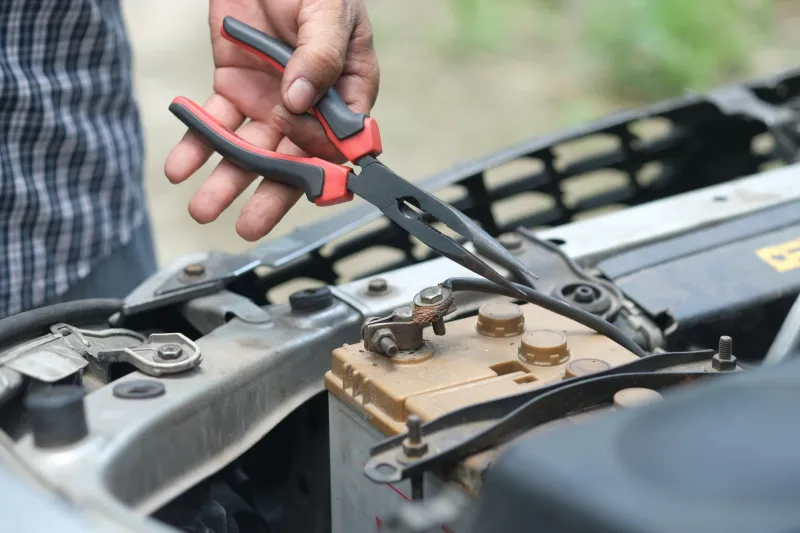
But the battery itself is only part of the story. Battery terminals—the connectors linking the battery to the vehicle's electrical system—are subject to a specific cold-weather degradation mechanism that receives far less attention. Road salt, moisture, and temperature cycling accelerate corrosion at terminal connections. Corroded terminals increase electrical resistance, which reduces effective cranking power and can cause voltage irregularities that affect modern vehicles' complex electronic systems. A battery that tests at acceptable voltage may still fail to start a vehicle reliably if the terminal connections are compromised.
For high-stress cold zone drivers, battery terminal inspection and cleaning should be a fall ritual, not an afterthought. Terminal replacement—a low-cost procedure involving parts that typically retail between $10 and $25—is warranted whenever corrosion has penetrated beyond the surface. A full battery replacement should be proactive rather than reactive: most automotive batteries have a service life of three to five years, and replacing a four-year-old battery before winter in Minnesota is a $150 to $200 investment that reliably prevents a $200 tow and an inconvenient cold-morning failure.
Cooling System Components: The Antifreeze Calculus
The term "antifreeze" is familiar to most American drivers, but the specific components of the cooling system that cold weather degrades most aggressively are less widely understood. The coolant itself—typically an ethylene glycol and water mixture—must be maintained at the correct concentration to prevent freezing. A 50/50 mix provides protection to approximately -34°F, adequate for most US regions. However, coolant also degrades chemically over time, losing its corrosion inhibitor package and becoming acidic, which attacks aluminum engine components and cooling system metals from the inside.
For high-stress cold zone drivers, coolant testing and replacement on the manufacturer's recommended schedule is not optional maintenance. The cost of a cooling system flush and fresh coolant—typically $80 to $150 at an independent shop, or a $30 to $50 DIY job—is trivially small compared to the cost of a damaged water pump, a corroded radiator, or an overheating event caused by a thermostat that has seized in the open position due to internal corrosion.
Additionally, coolant hoses and the radiator cap deserve specific attention in cold climates. Hoses that have become brittle from temperature cycling are at elevated risk of failure during cold starts, when the system transitions rapidly from ambient temperature to operating temperature. A visual inspection for cracking, hardness, or soft spots—and proactive replacement of hoses showing any of these characteristics—is a straightforward preventative measure with a parts cost typically under $50.
Undercarriage Components: The Silent Corrosion Campaign
For drivers in road-salt states, the undercarriage represents the most financially consequential cold-weather maintenance domain—and the most overlooked. Road salt is extraordinarily effective at preventing ice formation on roadways. It is equally effective at accelerating corrosion in the steel and cast-iron components that run beneath every vehicle.
The specific components most vulnerable to salt-accelerated deterioration include:
Brake lines. Steel brake lines exposed to repeated salt contact can develop external corrosion that progresses to internal weakness over multiple seasons. A brake line failure is a safety-critical event. In high-salt regions, brake line inspection should be part of every annual maintenance review, and replacement of lines showing significant corrosion should not be deferred.
Exhaust system components. Mufflers, resonators, and catalytic converter heat shields corrode faster in salt environments. While exhaust failures are not safety-critical in most cases, they are expensive: a full exhaust system replacement can run $500 to $1,500 depending on the vehicle, compared to the minimal cost of a heat shield repair or a muffler replacement addressed before complete failure.
Suspension and steering components. Ball joints, tie rod ends, and control arm bushings are all subject to accelerated wear when their protective boots crack in cold temperatures and allow salt-laden moisture to contact bearing surfaces. Suspension component failure has direct handling and safety implications; proactive inspection and replacement of worn boots—before the underlying components are contaminated—is substantially more cost-effective than replacing entire suspension assemblies.
Wheel well liners and undercoating. This is the preventative category that separates experienced cold-climate drivers from those still learning. Factory undercoating degrades over time; aftermarket undercoating application, performed before the vehicle's first northern winter or renewed every few years, creates a meaningful barrier against salt penetration. The cost—typically $100 to $300 for a professional application—is a fraction of the repair bills it prevents.
Building Your Regional Maintenance Calendar
The practical takeaway from this analysis is that cold-climate vehicle maintenance is not reactive—it is calendrical. The most cost-effective approach treats the late-summer and early-fall window as a preparation period, not a waiting period.
For high-stress cold zone drivers, an annual pre-winter checklist should include: battery and terminal inspection, coolant concentration and condition testing, hose and cap inspection, brake line visual assessment, suspension boot inspection, and undercarriage washing to remove accumulated summer road debris before salt season begins.
For moderate cold zone drivers, the same checklist applies on a less urgent timeline, with particular attention to battery health and coolant concentration.
For mild-zone drivers, the primary cold-weather consideration is preparation for the occasional severe event—ensuring coolant concentration is adequate for the region's minimum temperatures and that battery health is sufficient to handle the reduced cranking capacity that even mild cold imposes.
Geography is not destiny in automotive maintenance. But ignoring it is a reliable path to preventable repair bills and roadside emergencies that no driver, in any region, should have to experience.