Brake Pads on a Budget: The Dangerous Gamble Hiding Inside Your Wheel Wells
For most American drivers, the brake pad replacement is treated as a routine, almost mundane maintenance task. Walk into any auto parts store, scan the shelf, and the temptation is immediate: a set of pads for $19.99 sitting right next to a set priced at $74.99. The frugal instinct kicks in. They both stop the car, right?
The answer, according to engineers, safety researchers, and automotive technicians across the country, is a qualified and sobering: not exactly.
What Goes Into a Brake Pad—And What Gets Left Out
A brake pad is deceptively simple in appearance. In practice, it is a precisely engineered composite of friction materials, binding agents, steel backing plates, and thermal management compounds. Premium manufacturers invest heavily in the formulation of these materials, balancing stopping power, heat dissipation, rotor compatibility, and longevity through extensive testing cycles.
Budget manufacturers, by contrast, frequently cut costs at the formulation stage. Low-grade friction compounds may contain inconsistent filler materials, inferior binding resins, or poorly processed steel fibers. These substitutions are rarely visible to the naked eye, but their effects become apparent the moment braking demands exceed ordinary city driving.
The National Highway Traffic Safety Administration (NHTSA) has documented thousands of brake-related complaints annually in the United States, with a disproportionate number citing rapid fade, noise, vibration, and extended stopping distances—symptoms commonly associated with substandard friction material. While correlation is not causation, the pattern is difficult to ignore.
The Physics of Stopping Distance
Stopping distance is not merely a number in an owner's manual. At highway speeds, the difference of even a few feet can determine whether a driver avoids a collision or becomes part of one.
Quality brake pads are engineered to maintain consistent friction coefficients across a wide temperature range. This characteristic, known as thermal stability, ensures that the pad performs as reliably during an emergency stop from 70 mph as it does during a gentle deceleration at a neighborhood intersection.
Cheap pads frequently suffer from a phenomenon called brake fade—a condition in which the friction material overheats and temporarily loses its gripping capacity. During sustained heavy braking, such as descending a long grade or navigating stop-and-go traffic on a hot summer afternoon in Phoenix or Atlanta, budget pads can reach temperatures that cause their binding resins to vaporize. The resulting gas layer between pad and rotor reduces friction dramatically, extending stopping distances at precisely the moment when maximum braking performance is most critical.
Independent testing conducted by automotive safety organizations has demonstrated that vehicles equipped with low-quality brake pads can require stopping distances up to 20 percent longer than identical vehicles fitted with reputable friction components. On a highway at 65 mph, that translates to an additional 30 feet or more—roughly the length of a full-size pickup truck.
The Rotor Problem Nobody Mentions at the Register
Beyond the immediate safety implications, cheap brake pads inflict a secondary form of financial damage that rarely appears in the upfront price comparison: accelerated rotor wear.
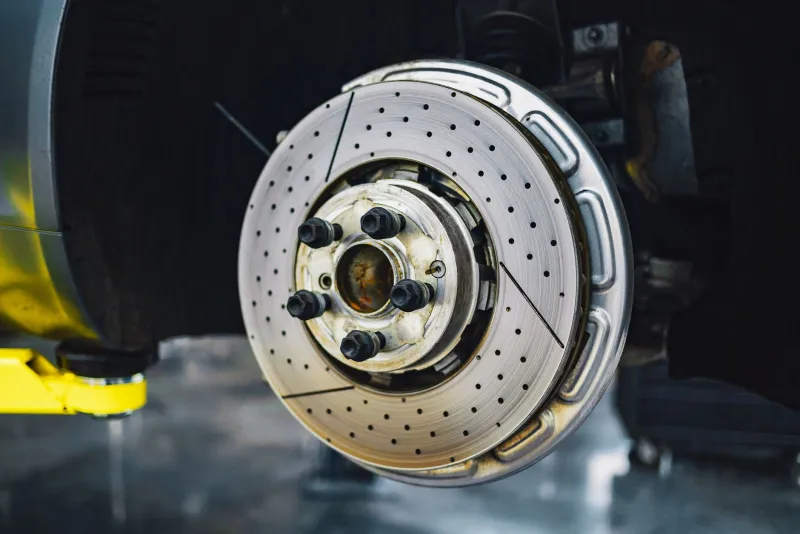
Rotors are precision-machined cast iron or composite discs that work in concert with brake pads to generate stopping force. Quality pads are formulated to be slightly softer than the rotor surface, ensuring that wear occurs primarily in the pad rather than the rotor. This design principle protects the more expensive component in the braking system.
Many discount pads invert this relationship. Aggressive, poorly balanced friction compounds can act almost abrasively against rotor surfaces, generating deep grooves, hot spots, and uneven wear patterns that compromise both braking performance and structural integrity. A rotor that might last 70,000 miles under quality pads may require replacement in as few as 20,000 miles when paired with inferior friction material.
The financial arithmetic here is unforgiving. A set of budget pads might save a driver $50 at the point of purchase. A single replacement rotor—particularly on a late-model vehicle with vented or slotted rotors—can cost between $80 and $200 per wheel. On a vehicle with four-wheel disc brakes, premature rotor replacement can easily run $400 to $800 in parts alone, before accounting for labor charges that typically range from $150 to $300 per axle at independent shops across the United States.
The $50 savings has, in this scenario, generated a $500 repair bill.
Caliper Damage: The Expensive Consequence Nobody Anticipates
The damage cascade does not necessarily stop at the rotors. Severely worn or poorly performing brake pads can also accelerate wear within the caliper assembly—the hydraulic component that clamps the pads against the rotor.
When pads wear beyond their minimum thickness without replacement, or when uneven wear patterns develop due to inconsistent friction material, caliper pistons can extend beyond their designed range of travel. This over-extension stresses piston seals, promotes fluid contamination, and in severe cases causes piston seizure. A seized caliper not only eliminates braking force on that wheel but can also cause the pad to drag continuously against the rotor, generating dangerous heat and, in extreme cases, igniting accumulated road debris.
Caliper replacement is among the more expensive brake system repairs a driver can face. Loaded caliper assemblies for common domestic and import vehicles typically range from $80 to $300 per unit, with some European and luxury applications exceeding $500. When compounded with rotor and pad replacement, a brake system repair originating from a single poor parts decision can approach or exceed $1,500.
How to Evaluate Brake Pads Before You Buy
Navigating the brake pad market requires understanding a few key indicators of quality. The following criteria can help drivers make informed decisions rather than defaulting to price as the primary filter.
Friction Rating Certification: Reputable brake pads carry edge codes stamped into their backing plates, representing friction coefficients established under SAE testing standards. Look for pads that carry documented friction ratings appropriate to your vehicle's application.
OEM Equivalency or Endorsement: Many aftermarket manufacturers produce pads that meet or exceed original equipment specifications. These products are engineered with the same rotor compatibility standards as factory components and represent a reliable middle ground between OEM pricing and budget alternatives.
Warranty Terms: Legitimate brake pad manufacturers stand behind their products with meaningful warranties. A pad offered without any warranty coverage is a significant red flag regarding the manufacturer's confidence in its own product.
Material Transparency: Quality manufacturers disclose their friction compound formulations—ceramic, semi-metallic, organic—and explain the intended application. Vague or absent product descriptions often indicate a lack of rigorous engineering documentation.
The True Cost Calculation
Responsible vehicle ownership requires evaluating parts not by their purchase price alone, but by their total cost across the full ownership period—a calculation that incorporates safety performance, component longevity, and the downstream repair expenses that poor-quality parts frequently generate.
In no system is this calculation more consequential than in the brakes. Every other component on a vehicle exists to move it forward. The braking system exists to keep it, and everyone inside it, alive.
At AutoPartsPro, our catalog reflects a commitment to components that meet verifiable quality standards across every make and model we serve. When it comes to friction components, we encourage every driver to look beyond the sticker price and consider the full picture—because the road ahead demands nothing less.